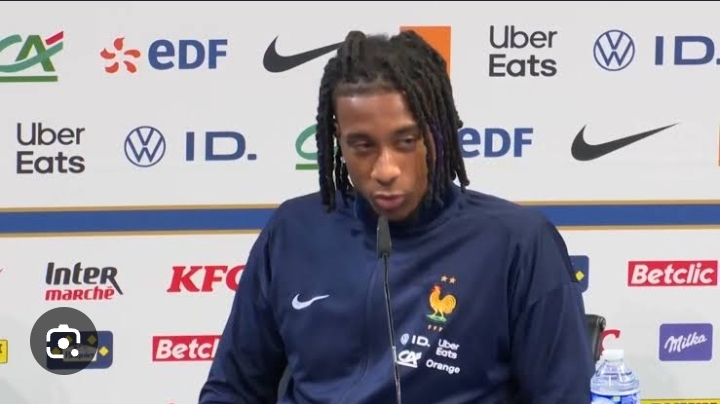
In a statement that has quickly stirred debate across European football circles, Michael Olise has reportedly admitted that he would rather face Atlético Madrid than Arsenal in a hypothetical UEFA Champions League final—citing the overwhelming defensive strength of the North London side as the key reason behind his preference.
Olise, known for his composure on the ball and creative brilliance in the attacking third, did not hesitate when asked about potential opponents at the highest stage of European football. While many players might instinctively lean toward avoiding a team like Atlético Madrid—renowned for their resilience and tactical discipline under Diego Simeone—Olise’s perspective offered a surprising twist. For him, Arsenal’s defensive organization presents an even more daunting challenge.
The French winger pointed specifically to Arsenal’s remarkable defensive structure, which has become one of the defining features of their campaign this season. Under the guidance of Mikel Arteta, Arsenal have transformed into a side that blends technical attacking football with a level of defensive solidity that rivals the very best in Europe. Their ability to maintain shape, press intelligently, and recover possession quickly has made them extremely difficult to break down.
Olise is believed to have highlighted players like William Saliba and Gabriel Magalhães as central to this defensive success. The partnership between the two has been widely praised for its balance of physicality, positioning, and composure under pressure. Saliba’s calmness in possession combined with Gabriel’s aggression and aerial dominance has created a defensive wall that very few teams have managed to penetrate consistently.
In contrast, while Atlético Madrid remain one of Europe’s most tactically disciplined teams, Olise appears to believe that their style—though difficult—offers more opportunities for attackers compared to Arsenal’s current setup. Atlético, under Simeone, often rely on a compact defensive block and quick counter-attacks, but they can sometimes concede possession and territory, leaving small windows for creative players to exploit.
Arsenal, on the other hand, have developed a more modern defensive system that integrates pressing, positional awareness, and technical ability. Their defenders are not only tasked with stopping attacks but also initiating play from the back, making it harder for opponents to even gain a foothold in the game. This dual-threat approach—defensive resilience combined with control in possession—is what Olise seems to find particularly challenging.
The comments come at a time when Arsenal’s defensive performances have drawn widespread admiration across the football world. Their recent displays in Europe have shown a team capable of absorbing pressure while remaining composed, often frustrating even the most clinical attacking sides. It is this consistency and discipline that appears to have left a strong impression on Olise.
For Atlético Madrid, being seen as the “preferred” opponent in this context is by no means a sign of weakness. The Spanish side has built its identity on resilience, grit, and tactical intelligence, and they remain one of the toughest teams to face in knockout football. However, Olise’s remarks underline just how far Arsenal have come in terms of defensive development.
Reactions to Olise’s statement have been mixed. Some fans view it as a compliment to Arsenal’s evolution under Arteta, while others see it as a subtle challenge—suggesting that the Gunners have now reached a level where even elite attackers are wary of facing them. Pundits, meanwhile, have pointed out that such comments add an extra layer of intrigue to any potential meeting between these European giants.
Ultimately, Olise’s preference speaks volumes about the shifting perceptions in European football. Arsenal, once primarily known for their attacking flair, are now being recognized as one of the most defensively formidable teams on the continent. And when a player of Olise’s quality openly admits he would rather avoid them on the biggest stage, it only reinforces the growing belief that this Arsenal side is built not just to compete—but to dominate.
Whether or not such a final ever materializes remains to be seen. But if it does, Olise’s words will undoubtedly resurface, adding fuel to what would already be a highly anticipated clash at the pinnacle of club football.