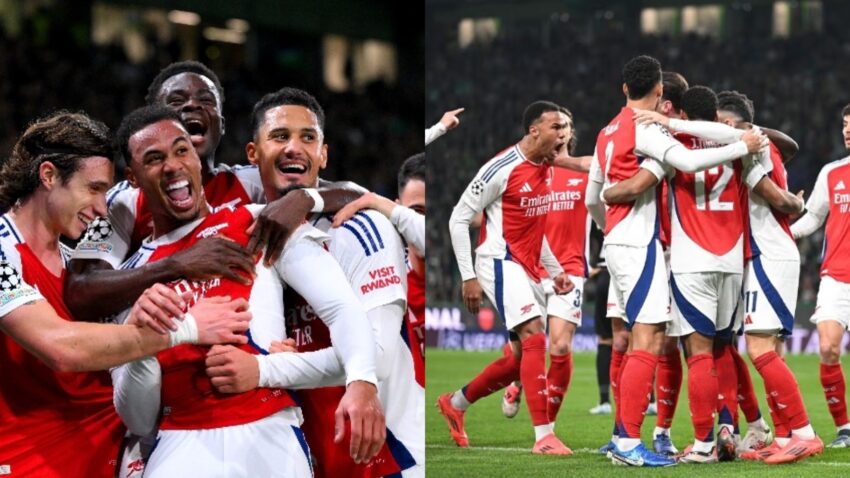
A growing wave of data-driven optimism is sweeping through North London after a leading predictive model—often referred to as a “supercomputer” in football analytics—has tipped Arsenal to win the Premier League title this season.
For a club that has spent recent years rebuilding under Mikel Arteta, such a projection is more than just numbers—it represents the culmination of a carefully constructed footballing vision.
Data Meets Destiny
Supercomputer predictions in modern football rely on vast datasets—ranging from expected goals (xG), player performance metrics, tactical efficiency, fixture difficulty, and historical trends. According to the latest simulations, Arsenal have emerged as slight but clear favorites ahead of defending champions Manchester City and other contenders.
The model reportedly ran thousands of season simulations, with Arsenal finishing top in a significant percentage of outcomes. While no algorithm can fully account for football’s unpredictability, the consistency of Arsenal’s performances has made them statistically the most balanced side in the league.
The Arteta Effect
Much of this optimism stems from the transformation overseen by Arteta. Since taking charge, the Spaniard has instilled a clear tactical identity—high pressing, positional play, and intelligent ball progression. Arsenal are no longer just a team with potential; they are now a side capable of controlling games against elite opposition.
Players like Martin Ødegaard have flourished under this system, providing creativity and leadership, while defensive stalwarts such as William Saliba have added resilience at the back. The balance between attack and defense has been crucial in turning Arsenal into genuine title contenders.
Squad Depth and Consistency
One of the biggest criticisms of Arsenal in previous campaigns was their lack of depth. However, this season has seen a more complete squad capable of rotating without significant drops in performance. Injuries—often the downfall of title challenges—have been better managed, and squad players have stepped up when needed.
The supercomputer’s prediction heavily factors in this consistency. Unlike some rivals who have shown fluctuations in form, Arsenal have maintained a steady points-per-game ratio, particularly against mid-table and lower-ranked teams—fixtures that often define title races.
The Manchester City Challenge
Of course, any prediction involving the Premier League must account for the relentless dominance of Manchester City under Pep Guardiola. City’s ability to string together long winning runs means no lead is ever truly safe.
However, the model suggests that Arsenal’s head-to-head performances and improved mental resilience could give them the edge this time around. Recent encounters between the two sides have shown that Arsenal are no longer overawed—they are competing, and in some cases, outperforming the reigning champions.
Key Factors in the Run-In
As the season approaches its decisive phase, several factors will determine whether the prediction becomes reality:
- Fixture Difficulty: Arsenal’s remaining schedule is considered relatively balanced, with fewer high-risk away games compared to some rivals.
- Injury Management: Keeping key players fit will be essential in maintaining momentum.
- Mental Strength: Title races are as much psychological as they are tactical. Arsenal’s ability to handle pressure will be tested.
Fans Dare to Dream
For Arsenal supporters, the idea of lifting the Premier League trophy is no longer a distant fantasy. It has been over two decades since their last league triumph, and this current squad has reignited belief across the fanbase.
While supercomputer predictions are not guarantees, they do reflect underlying truths—and right now, those truths point toward a team that has matured, evolved, and learned from past shortcomings.
Football will always retain its unpredictability—that’s what makes it compelling. Yet when data, form, and tactical progression all align, they paint a powerful picture. Arsenal’s rise to the शीर्ष of the Premier League table, backed by analytical projections, suggests that this could finally be their moment.
Whether they ultimately lift the trophy or not, one thing is clear: Arsenal are no longer chasing the title—they are leading the race.