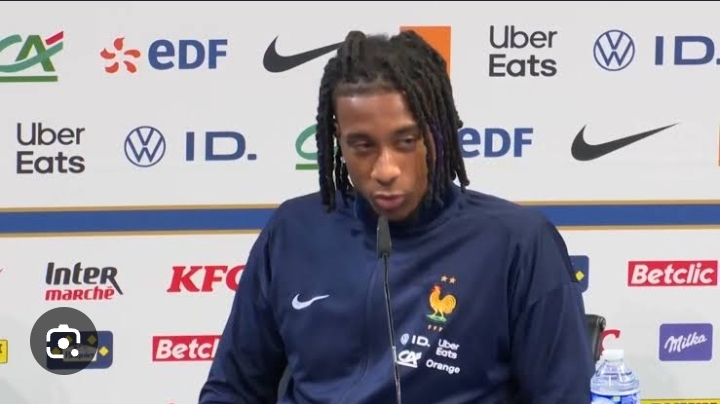
Michael Olise has stirred conversation across European football after revealing that he would prefer to face Arsenal F.C. in the final of this season’s UEFA Champions League.
The highly rated winger, who has been one of the standout attacking talents in Europe, made the comment during a recent interview, where he was asked about potential opponents in the competition’s showpiece event. Rather than opting for one of the traditionally dominant sides, Olise pointed toward Arsenal—an answer that has raised eyebrows and sparked debate among fans and analysts alike.
Olise’s reasoning appears to be rooted in both admiration and tactical preference. He praised Arsenal’s style of play under Mikel Arteta, describing it as open, expressive, and built on attacking intent. For a player of his profile—creative, technically gifted, and dangerous in one-on-one situations—such an opponent could offer more space and opportunities to influence the game compared to more defensively rigid teams.
“Arsenal play a very good brand of football,” Olise reportedly said. “They attack, they press, and they leave spaces. For players like me, those are the kinds of games you enjoy the most.”
His comments underline a broader perception of Arsenal’s transformation in recent seasons. Once criticized for inconsistency, the North London club has developed into one of Europe’s most exciting sides, blending youthful energy with tactical sophistication. Their attacking patterns, quick transitions, and positional fluidity have made them both entertaining and effective.
However, Olise’s statement can also be interpreted as a subtle suggestion that Arsenal, despite their quality, may be more vulnerable than some of their continental rivals in a one-off final. Teams that play expansive football often walk a fine line between dominance and exposure, and Olise seems confident that such an approach could be exploited on the biggest stage.
That said, facing Arsenal in a Champions League final would be far from straightforward. Arteta’s side has shown increasing maturity, particularly in high-pressure matches, where they have combined attacking flair with improved defensive organization. Their ability to control games through possession and press aggressively without the ball has made them a difficult opponent for any team.
Olise’s remarks have also added extra intrigue to the latter stages of the tournament. While reaching the final remains a significant challenge for all teams involved, comments like his contribute to the psychological narrative that often surrounds major European clashes. Players, managers, and fans alike will be watching closely to see how such statements play out if the scenario becomes reality.
For Arsenal, the idea of being “preferred opposition” could serve as added motivation. Elite teams often thrive on proving doubters wrong, and any suggestion that they might be the more favorable opponent is likely to fuel their determination to demonstrate their strength on the biggest stage.
Ultimately, Olise’s comments reflect both respect and confidence—respect for Arsenal’s quality and confidence in his own ability to perform against them. Whether his preference becomes reality remains to be seen, but one thing is certain: if such a final were to happen, it would promise an exciting, high-quality encounter between two sides unafraid to express themselves.
As the Champions League campaign reaches its climax, narratives like this only heighten anticipation. And should Arsenal and Olise’s team meet in the final, his words will undoubtedly resurface—adding another layer of drama to what would already be one of the most captivating fixtures in European football.