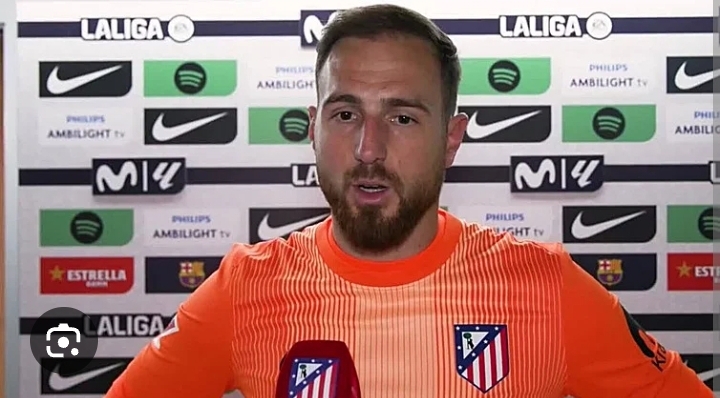
Jan Oblak has ignited fresh debate after openly admitting that Eberechi Eze was denied a clear penalty during Atlético Madrid’s tense encounter yesterday—but insisted he has no issue with the decision since it ultimately worked in his team’s favour.
The controversial moment came in the second half, when Eze drove into the penalty area and appeared to be brought down under pressure from Atlético defenders. Arsenal players immediately appealed, convinced the contact was enough for a spot-kick. Replays seemed to support their claims, showing what many believed to be a clear foul. However, the referee allowed play to continue, and VAR opted not to overturn the on-field decision.
Speaking after the match, Atlético’s goalkeeper Oblak delivered a surprisingly honest take on the incident—one that has quickly become a major talking point.
“To be fair, it looked like a penalty to me,” Oblak admitted. “If I’m being completely honest, I think they had a strong case. We’ve seen those given many times.”
Despite acknowledging the apparent mistake, the Slovenian shot-stopper made it clear that he was not dwelling on the controversy.
“But this is football,” he continued. “Sometimes you get decisions like this, sometimes you don’t. Today it went our way, and of course, I’m fine with that. As players, you just accept it and move on.”
His remarks have drawn mixed reactions across the football world. Some have praised Oblak for his honesty, noting that it is rare for players—especially those on the benefiting side—to admit when a decision has gone in their favour. Others, however, argue that such incidents underline ongoing concerns about consistency in refereeing and the application of VAR, particularly in high-stakes matches like a Champions League semi-final.
From Atlético’s perspective, the decision proved crucial. With the match hanging in the balance, conceding a penalty could have dramatically shifted momentum and possibly the outcome. Instead, Diego Simeone’s side maintained their composure, relying on their trademark defensive discipline to see out a valuable result.
For Arsenal, the frustration was evident. Players surrounded the referee after the incident, and the reaction from the bench suggested they felt a key moment had gone against them. In matches of this magnitude, such decisions can carry enormous weight, potentially influencing not just a single game, but the entire tie.
Atlético manager Diego Simeone, however, chose a more cautious approach when addressing the situation. “I haven’t seen it properly,” he said in his post-match interview. “The referee made his decision, and we respect it.”
The contrast between Simeone’s measured response and Oblak’s frank admission has only intensified discussion around the incident. It also highlights the different ways players and managers handle controversial moments—some opting for diplomacy, others choosing transparency.
As attention now turns to the decisive second leg, this moment is likely to remain a major subplot. Arsenal will feel they were denied a significant opportunity, while Atlético Madrid will take confidence from both the result and the fact that fortune, at least on this occasion, was on their side.
In the end, Oblak’s comments have ensured that the debate does not fade quickly. Whether it becomes a defining moment in the tie will depend on what unfolds next—but for now, it stands as yet another example of how fine margins and human decisions continue to shape football at the highest level.