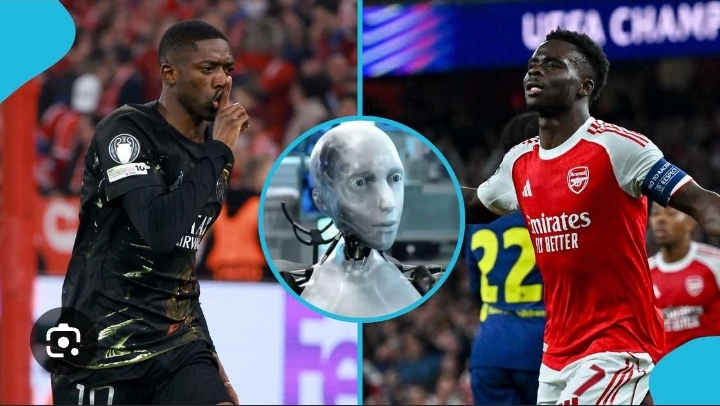
The stage is set for one of the biggest nights in European football as Arsenal prepare to face Paris Saint-Germain in the 2026 UEFA Champions League final in Budapest.
And according to several data simulations and football prediction models, the numbers are beginning to tilt in Arsenal’s favour — with one widely discussed supercomputer projection forecasting a 2-0 victory for Mikel Arteta’s side.
For Arsenal fans, it is the kind of prediction they have dreamed about for years. The club has not won the Champions League in its history, coming closest in 2006 when they lost to Barcelona in Paris. Now, exactly two decades later, the North London giants stand on the verge of rewriting their European story under the leadership of Mikel Arteta.
The reported supercomputer prediction is based on thousands of simulations involving recent form, defensive solidity, attacking efficiency, pressing intensity, injuries, possession numbers and expected goals. While PSG enter the final as defending European champions, Arsenal’s consistency throughout the season has convinced many analysts that they are slightly better balanced heading into the showdown.
One of the biggest reasons behind Arsenal’s advantage is their defensive structure. Throughout the Champions League campaign, Arsenal have looked organised, disciplined and extremely difficult to break down. Their pressing system has suffocated opponents across Europe, while their backline has shown remarkable composure under pressure.
Even PSG manager Luis Enrique recently admitted that Arsenal may currently be the best team in the world without the ball. The Spaniard praised Arteta’s side for their collective defending and tactical intelligence ahead of the final.
That praise explains why many prediction models believe Arsenal could keep a clean sheet in Budapest.
The supercomputer simulation reportedly expects Arsenal to dominate key moments of the game through midfield control and fast transitions. Players like Declan Rice and Martin Ødegaard are expected to play central roles, with Arsenal predicted to overwhelm PSG physically in midfield.
Rice, in particular, has become one of the symbols of Arsenal’s rise. His ball-winning ability, leadership and composure in major matches have transformed the team into genuine European contenders. Many analysts believe his ability to stop PSG’s counterattacks could decide the final.
Meanwhile, Ødegaard’s creativity and movement between the lines may prove difficult for PSG to contain. Arsenal’s captain has enjoyed one of the best seasons of his career and has delivered consistently in high-pressure matches.
The supercomputer also predicts Arsenal’s attack will eventually punish PSG’s aggressive style. While PSG possess dangerous forwards capable of changing games instantly, their attacking mentality can sometimes leave spaces behind their defence. Arsenal are expected to exploit those gaps with quick passing and direct movement.
There is also huge excitement surrounding Arsenal’s front line heading into the final. Whether it is through pace on the wings or movement through the centre, the Gunners have shown they can hurt teams in different ways. Their ability to score from set pieces has also become one of the strongest weapons in Europe this season.
PSG, however, remain an enormous threat.
The French champions have already eliminated several elite sides on their route to the final and are chasing back-to-back Champions League trophies. Their attacking unit has terrified defenders throughout the competition, and many neutral fans still believe they have the individual quality to produce magic on the biggest stage.
But according to the simulations, Arsenal’s collective structure gives them the edge.
A predicted 2-0 scoreline suggests a controlled performance rather than a chaotic thriller. The expectation is that Arsenal will stay compact defensively before striking at key moments, possibly through transitions or set-piece situations.
For Arteta, such a victory would cement his place among the elite managers in world football. Since taking charge, he has rebuilt Arsenal step by step, turning them from an inconsistent side into Premier League champions and now Champions League finalists.
Winning Europe’s biggest trophy would complete one of the most impressive rebuilds in modern football.
The final itself is scheduled to take place at the famous Puskás Aréna in Budapest on May 30, 2026. It will be Arsenal’s second appearance in a Champions League final and PSG’s third overall.
Across social media, Arsenal supporters are already dreaming of history. Many fans believe this current team has the mentality and maturity needed to finally conquer Europe. The confidence around the club has only grown stronger since the supercomputer prediction surfaced online.
Of course, football is never decided by algorithms alone. Finals often come down to moments of brilliance, individual mistakes or nerves under pressure. PSG have enough quality to punish any weakness, and one moment from their star attackers could completely change the game.
Still, the numbers are speaking loudly.
The data models see Arsenal as the more complete team. The defensive organisation, midfield intensity, tactical discipline and growing confidence of Arteta’s squad have convinced many analysts that the Gunners are ready for European glory.
If the supercomputer prediction proves correct, Arsenal fans may finally witness the moment they have waited decades to see — their club lifting the UEFA Champions League trophy for the very first time after a famous 2-0 victory over PSG in Budapest.