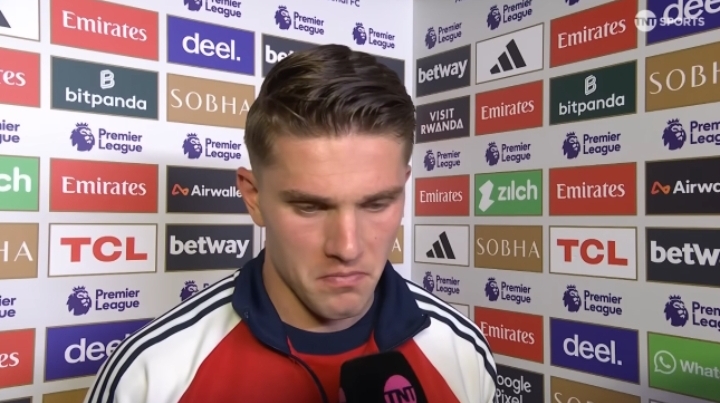
Tensions appear to be quietly building inside Arsenal’s dressing room following their damaging defeat to Bournemouth, with Viktor Gyokeres reportedly frustrated by what he sees as a lack of creativity from Kai Havertz in midfield during the match.
The Gunners suffered a shock 2-1 loss at the Emirates, a result that has raised serious concerns about their attacking cohesion and ability to control games when it matters most. Despite Gyokeres getting on the scoresheet from the penalty spot, Arsenal struggled to create clear-cut chances throughout the game, with much of their play described as slow, predictable, and lacking imagination.
Sources close to the situation suggest that Gyokeres was particularly unhappy with the service he received, or rather the lack of it, from deeper areas of the pitch. The Swedish forward, known for his intelligent movement and ability to exploit spaces behind defensive lines, was often seen making runs that went unnoticed or ignored, leaving him isolated for long spells.
After the match, Gyokeres hinted at the issue without directly naming teammates, admitting that Arsenal simply did not create enough in attack to win the game. He emphasized that while the team felt in control after equalising, they failed to turn possession into meaningful opportunities.
That subtle admission has been widely interpreted as a reflection of deeper problems in midfield creativity, with Havertz—who often operates in advanced midfield roles—coming under increasing scrutiny. While the German international has been praised in the past for his versatility and work rate, his performance against Bournemouth has drawn criticism for failing to unlock the opposition’s defence or provide the decisive passes needed to feed the striker.
Analysts reviewing the game pointed out that Arsenal generated very little from open play, relying heavily on set pieces and moments rather than sustained attacking patterns. In fact, the team produced one of their lowest attacking outputs at home this season, highlighting just how ineffective their creative unit was on the day.
For a striker like Gyokeres, whose game thrives on service and quick transitions, this lack of supply can be particularly frustrating. His strength lies not just in finishing but also in timing runs and linking play, yet without midfielders consistently finding him, his influence becomes limited. Observers noted that he was often forced to drop deeper or drift wide just to get involved, a clear sign that the connection between midfield and attack was not functioning properly.
The situation has inevitably put Havertz in the spotlight. A player of his profile—technically gifted and capable of playing both as an attacking midfielder and forward—is expected to be a key creative outlet. However, against Bournemouth, he struggled to impose himself, with Arsenal failing to gain any real foothold in the game despite dominating possession at times.
This disconnect between midfield and attack is now becoming a recurring theme in Arsenal’s recent performances. Critics argue that when the team is unable to move the ball quickly and incisively through the middle, players like Gyokeres are left feeding off scraps, drastically reducing their effectiveness in front of goal.
The defeat has also intensified pressure on manager Mikel Arteta, who admitted the result felt like a “big punch in the face” and called for immediate improvement. With the title race tightening and rivals closing in, Arsenal can ill afford more performances where their attacking unit fails to click.
For Gyokeres, the frustration is understandable. Strikers are often judged on goals, but their ability to deliver is heavily dependent on the quality of service they receive. If the midfield, led by players like Havertz, cannot consistently provide that creativity, Arsenal risk wasting the talents of one of their most dangerous forwards.
As the fallout from the Bournemouth defeat continues, all eyes will be on how Arsenal respond—not just in terms of results, but in rebuilding the chemistry between midfield and attack. Because if that connection isn’t fixed quickly, frustrations like Gyokeres’ could grow into a much bigger problem for the club’s title ambitions.