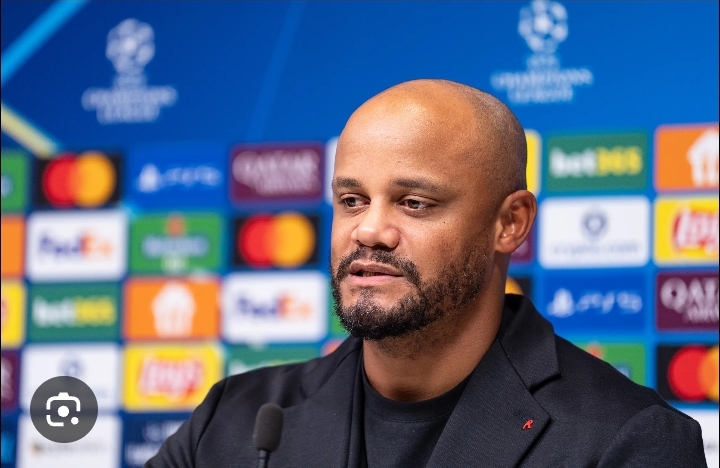
Vincent Kompany has sparked widespread discussion across European football after admitting that watching Arsenal dismantle Fulham left him with genuine concern about the prospect of facing them in a potential UEFA Champions League final.
The former Manchester City captain, now building his reputation as a top-level coach, did not shy away from expressing just how formidable he believes this Arsenal side has become.
Speaking after closely analyzing the game, Kompany described Arsenal’s performance as “complete in every sense,” highlighting the intensity, tactical discipline, and attacking ruthlessness that defined their victory. According to him, it wasn’t just the scoreline that stood out, but the manner in which Mikel Arteta’s side controlled every phase of play. “When you watch a team like that,” Kompany reportedly said, “you don’t just see quality—you see a team that knows exactly what it’s doing at every moment.”
Arsenal’s display against Fulham was one of authority from start to finish. They pressed high, recovered possession quickly, and transitioned seamlessly between defense and attack. Kompany pointed out that this ability to dominate both with and without the ball is what separates good teams from elite ones. For a manager preparing for the highest level of European competition, such qualities are not just impressive—they are intimidating.
What appeared to unsettle Kompany the most was Arsenal’s defensive structure. Despite their attacking dominance, they remained compact and disciplined at the back, leaving Fulham with little room to exploit. Kompany, himself a legendary defender during his playing days, emphasized how difficult it is to break down a team that combines organization with intelligence. “They don’t give you chances,” he noted. “And at this level, that’s everything.”
In attack, Arsenal’s fluidity has become one of their defining features. Kompany observed how players interchange positions effortlessly, creating confusion for defenders and opening up spaces in dangerous areas. This unpredictability, coupled with clinical finishing, makes them a nightmare to prepare for. He suggested that any team facing Arsenal in a Champions League final would need to be “perfect” to stand a chance.
The psychological aspect of Arsenal’s rise was another key theme in Kompany’s remarks. He spoke about the confidence and belief radiating from the squad, something that is often built through consistent performances like the one against Fulham. “You can see it in the way they play,” he said. “They believe they can beat anyone, anywhere.” For Kompany, this mentality is what turns strong teams into champions.
There is also a deeper layer to his comments. As someone who has experienced the pressures of elite competition—both in the Premier League and on the European stage—Kompany understands what it takes to succeed in high-stakes matches. His acknowledgment of Arsenal’s strength is not casual praise; it is a calculated assessment from a football mind that recognizes the warning signs of a team peaking at the right time.
Arsenal’s transformation under Arteta has been gradual but deliberate. From a side once criticized for inconsistency, they have evolved into a cohesive, tactically sophisticated unit capable of controlling games against any opposition. Kompany’s reaction to their performance against Fulham underscores just how far they have come—and how seriously they are now being taken across Europe.
Of course, the idea of a Champions League final featuring Arsenal remains a hypothetical scenario, but it is one that is increasingly being discussed as the season progresses. With each dominant performance, the Gunners strengthen their case as genuine contenders not just domestically, but on the continental stage as well.
Kompany was careful to note that football remains unpredictable, especially in knockout competitions where small moments can decide outcomes. However, his admission of being “scared” at the thought of facing Arsenal speaks volumes. It reflects a growing consensus that this team possesses the balance, depth, and mentality required to compete with—and potentially overcome—the very best in Europe.
For Arsenal, such comments serve as both recognition and motivation. Being feared is often a sign of respect, but it also brings added pressure and expectation. The challenge now is to maintain their level, stay focused, and continue delivering performances that justify the growing hype.
As the season unfolds, the possibility of Arsenal reaching a Champions League final will continue to capture attention. And if they do, Kompany’s words may well echo louder than ever. For now, one thing is clear: Arsenal are no longer just participants on the big stage—they are a team others are beginning to fear.