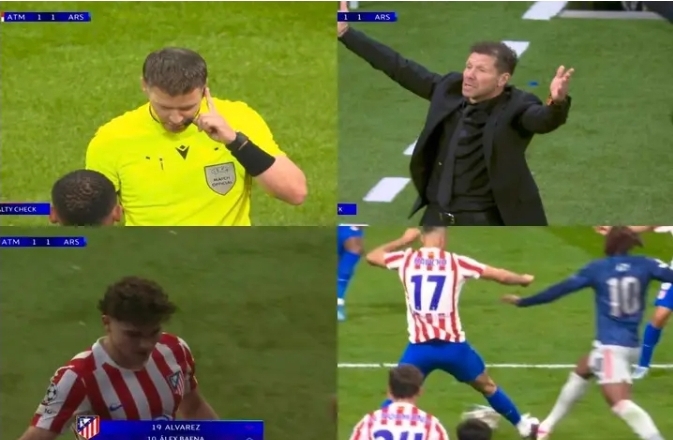
UEFA have officially concluded their investigation into the performance of Danny Makkelie following the highly controversial UEFA Champions League clash between Arsenal and Atletico Madrid, bringing an end to days of intense scrutiny, debate, and speculation across the football world.
The Dutch referee found himself at the center of attention after a series of contentious decisions during the tightly contested encounter, most notably a penalty appeal involving Arsenal that was waved away. The incident, which many pundits and fans argued should have resulted in a spot-kick, quickly became one of the defining talking points of the match and ultimately prompted UEFA to launch a formal review.
In their final report, UEFA acknowledged that while the match was handled within acceptable officiating standards overall, there were “key moments” that required deeper analysis. According to sources familiar with the findings, the governing body stopped short of issuing any severe disciplinary action against Makkelie but did highlight areas where improved judgment and communication could have led to a more satisfactory outcome.
UEFA’s refereeing committee reportedly focused heavily on the decision not to award Arsenal a penalty, assessing both the on-field call and the role of the Video Assistant Referee (VAR) in the situation. While the conclusion did not explicitly label the decision as a clear error, it suggested that the incident fell into a “gray area” where a different interpretation could have justifiably led to a penalty being awarded.
The statement emphasized that such marginal decisions are part of the complexity of modern football officiating, particularly in high-pressure matches at the Champions League level. However, UEFA also reiterated its commitment to consistency and transparency, noting that internal feedback has been provided to Makkelie and the officiating team involved.
For Arsenal, the conclusion may feel like a partial validation but not full justice. The North London club and their supporters had expressed frustration in the aftermath of the match, believing that the denied penalty could have significantly altered the outcome. Several former players and analysts had publicly criticized the decision, intensifying pressure on UEFA to address the situation.
On the other side, Atletico Madrid maintained that the referee’s decisions were part of the game and defended the integrity of the officiating. The Spanish side, known for their resilience and tactical discipline, were content to let UEFA’s process run its course without making strong public complaints.
UEFA also used the conclusion of the investigation to reaffirm confidence in Makkelie, who remains one of Europe’s most experienced referees. Despite the controversy, the governing body made it clear that the incident would not define his career, and he is expected to continue officiating at the highest level.
The outcome has sparked mixed reactions across the football community. Some observers believe UEFA missed an opportunity to take a stronger stance and set a clearer precedent, while others argue that the nuanced nature of refereeing decisions makes absolute judgments difficult.
Ultimately, the investigation highlights the ongoing challenges surrounding officiating in modern football, where every major decision is dissected in real time and subjected to intense public scrutiny. As technology like VAR continues to play a larger role, expectations for accuracy and consistency have never been higher.
With the case now closed, attention will inevitably return to the pitch, where both Arsenal and Atletico Madrid remain focused on their European ambitions. But the controversy surrounding that night will linger as yet another example of how fine margins and human judgment can shape the outcome of even the biggest matches in world football.