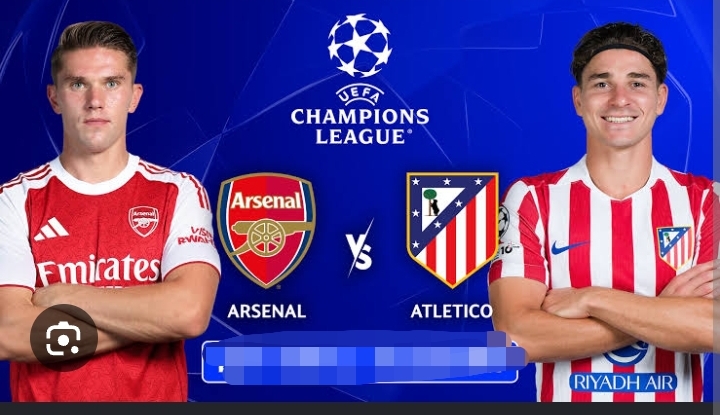
Erling Haaland has ignited fresh debate ahead of the UEFA Champions League semi-finals after revealing that he would prefer to see Atlético Madrid reach the final rather than Arsenal—a statement that is already stirring strong reactions across the football world.
The Manchester City striker, known for his directness both on and off the pitch, reportedly made the comments during a media session where he was asked to assess the remaining teams in Europe’s elite competition. While Haaland acknowledged the quality present in both sides, he was clear in his preference, pointing to stylistic differences and tactical challenges as key reasons behind his stance.
Haaland is believed to have highlighted Atlético Madrid’s approach under Diego Simeone as something he respects and, in some ways, finds more predictable to play against compared to the evolving system of Arsenal. Atlético’s disciplined defensive structure, deep block, and reliance on quick transitions have been a hallmark of Simeone’s tenure, and while they can be incredibly difficult to break down, they follow a more familiar pattern for elite forwards.
In contrast, Haaland suggested that Arsenal’s current setup under Mikel Arteta presents a more complex and demanding challenge. The Norwegian striker reportedly pointed out that Arsenal’s defensive organization combined with their ability to press high and control spaces makes them one of the most uncomfortable teams to face in Europe right now. “They don’t give you anything,” he is believed to have said. “Every movement is tracked, every space is covered.”
This perceived unpredictability appears to be a major factor in Haaland’s preference. Arsenal’s tactical flexibility allows them to adapt mid-game, switching between pressing aggressively and sitting compact when needed. For a striker who thrives on space and quick service into dangerous areas, such adaptability can significantly limit opportunities.
Haaland’s remarks also touched on the physical and mental demands of facing Arsenal’s defense. With players like William Saliba and Gabriel Magalhães forming a formidable partnership at the back, Arsenal have developed a reputation for neutralizing even the most prolific attackers. Haaland, who has faced a variety of defensive systems across Europe, reportedly acknowledged that breaking down such a well-drilled unit requires near-perfect execution.
On the other hand, Atlético Madrid’s defensive style, while equally resilient, often invites pressure and concedes possession. Haaland hinted that this could create more opportunities for attackers willing to remain patient and capitalize on moments when the defensive line is stretched or transitions are not perfectly executed.
The comments have inevitably sparked discussion among fans and pundits, with some interpreting Haaland’s preference as a subtle admission of Arsenal’s growing stature in European football. Being viewed as the tougher opponent by one of the world’s most feared strikers is a testament to the progress Arsenal have made under Arteta.
However, others see it as a reflection of tactical compatibility rather than outright superiority. Football at this level often comes down to matchups, and Haaland’s perspective underscores how different styles can influence player preferences and expectations.
For Atlético Madrid, Haaland’s endorsement could serve as a boost, reinforcing the effectiveness of Simeone’s long-standing philosophy. For Arsenal, it may act as further motivation—a reminder that they are now seen as a benchmark, a team capable of unsettling even the most elite talents.
As the semi-finals approach, Haaland’s comments have added another layer of intrigue to an already highly anticipated stage of the competition. Whether his preference proves justified will ultimately be decided on the pitch, where both Atlético Madrid and Arsenal will aim to prove that they belong in the final.
One thing is certain: when a striker of Haaland’s caliber openly expresses a preference, it reflects not just personal opinion, but a deeper recognition of the tactical battles that define modern football at the highest level.